Freedom Is All You Need
A strong military is built on liberty — not the other way around.


Pete Hegseth is on a mission. Our new Secretary of Defense wants to rebuild the strongest military in the world to protect freedom. I say: go for it. We must defend ourselves against totalitarian adversaries, and the best way to do that is through technological deterrence — by building a military so technologically advanced that no rational enemy would even consider attacking us.
In principle, this is an excellent goal, and I believe Hegseth means what he says. But here’s the catch: it is not our great military that protects freedom. It is freedom that creates and sustains a great military. Only freedom can generate the technological advancements necessary to keep aggressors at bay.
Technological deterrence is an ancient strategy in warfare, dating back to the earliest civilizations on the Eurasian steppes. It is best captured by Bruce Lee’s iconic line from Enter the Dragon: “My style? You can call it the art of fighting without fighting.”

An adversary will not attack if their chance of victory is close to zero. The central thesis of this essay is that technological deterrence ultimately rests on liberty — not the reverse.
In this piece, we will use “freedom” and “liberty” largely as synonyms. In principle, however, they carry slightly different connotations: freedom refers to a system in which people make decentralized and voluntary decisions, while liberty is the protected right to do so. To complete the picture, we draw on Karl Popper’s insight about open societies: existing power structures must be replaceable by better solutions without violence. This principle of peaceful, voluntary replacement applies not only to politics but also to science, business, philosophy, law, art — virtually every domain that matters in society.
We argue that a free society holds a decisive unfair advantage over totalitarian regimes. Freedom fosters rapid knowledge creation, which in turn drives technological superiority. Most crucially, freedom also generates the moral and civil norms that allow a society to become dominant without destroying itself from within. That is why freedom is indispensable: it is precisely our freedom that gives us the superpower of developing superior technologies — technologies that then enable us to protect that very freedom. In short, great armies do not protect freedom; great freedom creates great armies.
This essay proceeds as follows. First, we outline the conditions required for a truly free society. Then we show why freedom and knowledge creation are two sides of the same coin — each reinforcing the other in a virtuous cycle. It becomes an avalanche of better solutions to problems that leads to an advanced civilization. Crucially, this is not only about technological innovation. A free society must also innovate along moral and civil dimensions to keep its own demons in check. When you become nearly invincible externally, your greatest threat becomes internal — and that threat must be restrained through continuous advancement in social, legal, moral, and civil spheres.

History shows many technologically advanced but unfree societies: the Mongols under Genghis Khan, Nazi Germany under Hitler, and contemporary China under the Communist Party. None could ultimately match the sustained power of a genuinely free society because their pace of innovation is structurally slower. A society grounded in decentralized and voluntary decision-making corrects errors faster and replaces outdated norms with better ones more effectively. We will explore this key epistemological advantage in depth. Finally, we argue that we must invest heavily in both our technological infrastructure and our moral and ethical frameworks. Only this balance will keep us ahead. Freedom, in the end, is the true foundation of a strong military.
No Throat to Choke
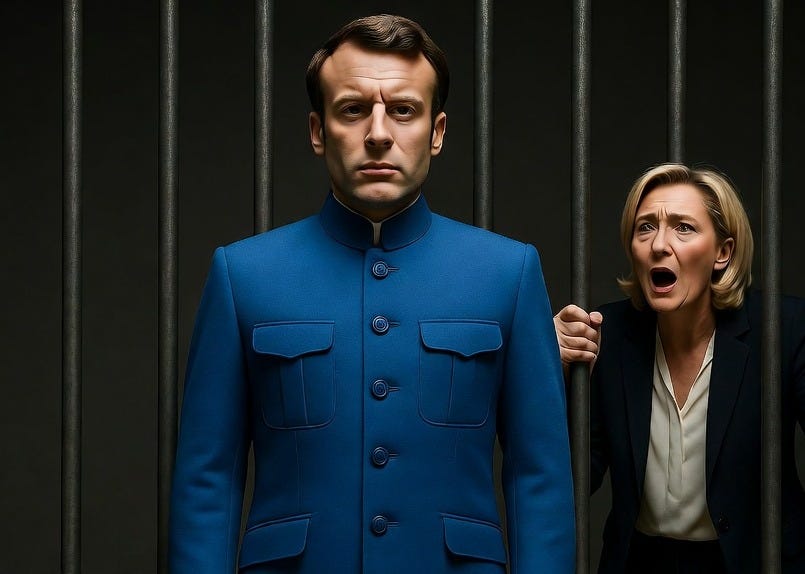
Even Karl Popper, one of the greatest defenders of open societies, recognized freedom’s inherent vulnerability — what is often called the paradox of tolerance (and by extension, of freedom). If a society tolerates everything, including those who would destroy tolerance, the strong will eventually subdue the weak. This is the justification many Western governments now use when restricting free speech. Yet Popper also warned against abusing this insight under false pretenses. When leaders like French President Macron declare “Free speech is bullshit” in the name of civil order, they cross a dangerous line.
Freedom is indeed an elusive concept — difficult to define precisely, yet instantly recognizable when present. For this essay, we ground it in decentralized voluntary decision-making. It is not the complete picture, but it is the essential foundation: many individuals making their own choices, with effective mechanisms for aggregating those choices into collective outcomes.
Democracy aggregates via elections, markets via capital allocation, science via peer review and citations. One of the most powerful modern examples is the Bitcoin network — a truly decentralized system in which the voluntary actions of millions produce a single, tamper-resistant ledger. There is no throat to choke. You cannot easily corrupt or destroy it. Even if every computer on Earth were eliminated, the core idea could survive in people’s minds. You would essentially have to destroy human civilization to eliminate it.
Bitcoin serves as a powerful blueprint for technologies that can underpin a genuinely free society. A key hallmark of freedom is that there should be no single point of failure — no throat to choke — because any such point will eventually be corrupted.
The Avalanche of Hope
Freedom is the ultimate driver of knowledge and innovation. Ludwig von Mises explained this through his famous economic calculation problem. Centralized planners simply cannot match the speed and accuracy of millions of individuals making decisions in real time. By the time central authorities recognize and correct their mistakes, those errors have often compounded catastrophically.
This same principle applies far beyond economics — to science, law, technology, and governance. Free societies aggregate information and correct course continuously. Imagine science under a dictator: researchers would waste their energy trying to please the ruler rather than pursuing truth. The scientific method itself is predicated on freedom — the freedom to argue, to challenge, to test, and to replace weaker ideas with stronger ones without violence. Academic discourse must be filled with vigorous debate. Science needs the oxygen of freedom to flourish.

We must fiercely protect this culture in our universities and research institutions if we wish to lead in rocketry, materials science, energy, and AI — all critical for technological deterrence. Freedom is our true superpower. It is the one advantage that China, Russia, and other authoritarian regimes fundamentally lack. Even Europe does not enjoy the same degree of freedom we have in the United States. We must guard this advantage at all costs.
More freedom produces more knowledge, which produces even more freedom. This self-reinforcing cycle is what we call the avalanche of hope.
Keep Prometheus in Check

Technological progress must be matched by moral and societal progress. This is where totalitarian states consistently fail. While they may produce many talented scientists, their societies remain rigidly controlled by design. China constantly speaks of “stability,” which really means resisting fundamental change in governance.
But technology and society cannot be decoupled. New tools — nuclear power, AI, robotics, social media, space exploration — inevitably create new ethical and social challenges. We must evolve our institutions alongside our technology. Universities should invest as heavily in moral philosophy and ethics as they do in laboratories. The overarching goal must always be to preserve and strengthen freedom, because without it, none of our other achievements are sustainable.
Technological deterrence ultimately depends on freedom.
The Anatomy of Freedom
Freedom is a disruptive technology. For millennia, societies nurtured science and philosophy. Long before the Greek philosophers, thinkers across the Eurasian steppes explored mathematics, astronomy, and ethics. But the Greek city-states introduced something radically new: a fierce commitment to freedom of speech and thought. The Romans later built a republic on these foundations, though it eventually gave way to empire and dictatorship. It took more than a thousand years for the spark of liberty to reignite powerfully during the Renaissance, which introduced empirical science and the modern scientific method.
This was the birth of decentralized, voluntary decision-making in science — later extended to politics, most successfully in the United States after the Revolutionary War. Decentralized voluntary decision-making is the very anatomy of freedom. Remove either element and freedom collapses.
“The aim of science is not to open the door to infinite wisdom, but to set a limit to infinite error.” — Bertolt Brecht
Bitcoin offers one of the purest modern examples of decentralized decision-making. But science itself was one of the first great decentralized networks. As universities proliferated across Europe and America, they became nodes of independent inquiry. Competing ideas in mechanics, optics, chemistry, and astronomy drove an unprecedented scientific revolution.
The engine of progress is rapid iteration and error correction. Progress is not measured in calendar time but in the number of meaningful iterations. Central authorities are always too slow. This is the ultimate advantage of freedom.
Decentralized decision-making alone is not enough. China today has a vast academic and technological apparatus, but it is not voluntary — it operates under coercion and political control. Voluntary decision-making comes from within, aligned with one’s own values and free from external pressure. It is the kind of choice you would proudly tell your grandchildren about.
Freedom Is Where the Embassy Lines Are Longest

Freedom has been profoundly disruptive throughout history and it remains relatively rare today. For all intents and purposes, the United States is where the modern spirit of freedom is lived most fully. One simple but telling metric confirms this: look at the length of the lines outside U.S. embassies around the world. People vote with their feet.
This is why the United States remains the world’s most powerful nation — not because of superior natural resources or population size, but because freedom is a disruptive force that creates an unfair advantage adversaries cannot easily recognize, let alone match.
Historians often credit America’s industrial might for victory in World Wars I and II. Yet China, Russia, and parts of Europe were comparably powerful at the time. What made the difference was freedom-driven innovation, which ultimately defeated the Nazis, Imperial Japan, and later the Soviets.
The same dynamic holds today. China has numbers, discipline, and centralized power. The United States has bureaucracy, division, NIMBYism, and fierce cultural debates. Yet freedom remains our decisive edge — the force that allows faster correction, bolder experimentation, and genuine creativity.
That is why we possess the world’s most technologically advanced military — one that deters potential aggressors through sheer superiority. To keep winning, we must fiercely protect the source of that superpower: our freedom.
Freedom is all you need.